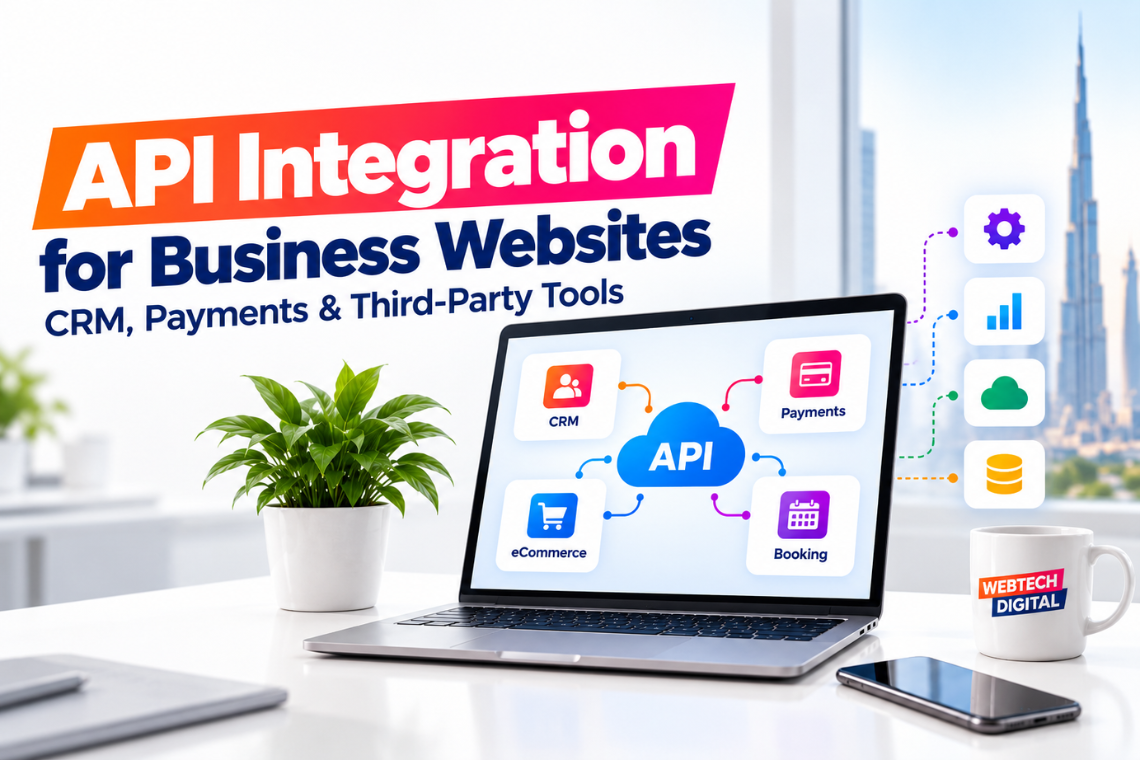
API Integration for Business Websites: CRM, Payment Gateways and Third-Party Tools
A business website often starts with a simple purpose: explain the company's services, generate enquiries or sell products. As the business grows, however, the website needs to do more. Sales teams need customer information, finance teams need accurate payment records, and operations teams need data to move between different software systems without repeated manual work.
This is where API integration becomes useful.
An API allows different applications to exchange information and perform specific actions through a defined interface. When implemented properly, it can connect a website with a customer relationship management (CRM) system, payment gateway, inventory platform, booking tool or other business software.
For companies in Dubai and across the UAE, the right integrations can reduce administrative work, improve data accuracy and make everyday business processes easier to manage. The challenge is choosing the right connections and implementing them securely.
What Is API Integration for a Business Website?
API integration connects a website or web application with another software system so that they can exchange data or trigger actions automatically.
For example, when a visitor submits an enquiry form, an integration could send the customer's details to a CRM, assign the lead to a salesperson and trigger a confirmation email.
Common applications include:
 Sending website enquiries directly to a CRM.
Accepting online payments through a payment gateway.
Synchronising products and inventory with an eCommerce platform.
Connecting appointment bookings to a scheduling system.
Sending order information to accounting or delivery software.
Displaying information from an external service on a website.
The main advantage is that information can move between systems without employees having to copy the same details manually. The actual benefits depend on the quality of the integration, the capabilities of the connected applications and the business process being automated.
Why Businesses in Dubai Need Website API Integration
Many businesses use several digital tools to manage sales, payments, customer support and daily operations. When these systems operate independently, staff may need to enter the same information multiple times or switch between platforms to complete routine tasks.
Business API integration in the UAE can help address these problems by connecting existing software around the way a company works.
Consider a Dubai-based service provider that receives enquiries through its website. Without an integration, employees might copy each enquiry into a spreadsheet, forward it to the sales team and update the CRM later. This creates opportunities for delays and inconsistent records.
With a properly designed integration, the enquiry can be recorded in the CRM as soon as it is submitted. The sales team can access the information in one place, while automated workflows handle appropriate notifications and assignments.
Businesses may benefit through:
Less repetitive data entry.
Faster handling of customer enquiries.
More consistent records across applications.
Better visibility into sales and order activity.
Fewer avoidable errors in routine workflows.
More flexibility as business requirements change.
Integration is not automatically the best solution for every process. Before development begins, identify the actual bottleneck and confirm that the systems involved support the required functionality.
CRM API Integration: Turning Website Enquiries into Action
A CRM system helps businesses manage leads, customer information, sales opportunities and follow-up activities. Connecting it to a website makes the information collected online more useful to the teams responsible for responding.
How Website CRM Integration Works
A typical CRM integration follows a straightforward process:
A visitor submits a contact form or requests a quotation.
The website validates the submitted information.
The server sends the relevant details to the CRM through its API.
The CRM creates or updates a lead according to the agreed rules.
The system may assign the lead, record its source or trigger a notification.
For example, a web development company could record whether an enquiry came from an SEO service page, a paid advertising landing page or a referral form. This gives the sales team useful context before contacting the prospect.
A well-planned CRM API integration should also address duplicate records, failed requests, consent requirements and field mapping. If a CRM expects a phone number in one format while the website collects another, the integration needs to handle that difference reliably.
The goal is not simply to transfer data. It is to ensure the information reaches the right place in a form the business can actually use.
Payment Gateway API Integration for Secure Online Transactions
Payment gateway API integration allows a website to connect with a payment provider so customers can complete transactions online.
This is particularly important for eCommerce stores, booking websites, subscription services and businesses that collect deposits or service fees.
A typical transaction works as follows:
The customer selects a product or service and proceeds to checkout.
The website creates an order and initiates the payment process.
The payment provider handles the transaction through its approved payment flow.
The provider returns the payment status or sends a server-to-server notification.
The website updates the order after verifying the transaction result.
A successful redirect to a confirmation page should not be treated as sufficient proof that payment has been completed. Developers should verify payment notifications or retrieve the transaction status through the provider's API before marking an order as paid.
Security is equally important. Use HTTPS, keep secret API credentials on the server, verify webhook signatures where supported and prevent the same payment notification from processing an order twice.
For businesses operating in the UAE, provider selection should account for supported currencies, settlement arrangements, transaction fees, available payment methods and business eligibility. Card-data handling must also follow the applicable payment security requirements.
The right implementation makes checkout more reliable without exposing sensitive payment information unnecessarily.
Third-Party API Integration Services for Business Automation
CRM and payment systems are only two examples of what a website can connect to. Third-party API integration services can link websites with specialised tools that support other business functions.
Common examples include:
Accounting software: Transfer relevant invoices, order details or transaction records into an accounting platform, subject to the software's capabilities.
Shipping and logistics: Send order information to delivery providers and retrieve shipment updates or tracking details.
Booking systems: Display availability, create appointments and synchronise reservations with an external scheduling platform.
Marketing tools: Send consented subscriber information or qualifying lead events to supported email marketing and analytics systems.
Inventory management: Synchronise stock information between an online store and an inventory platform.
Before selecting an integration, confirm that the external service offers a suitable API, supports the required data fields and permits the intended use. Some platforms require paid subscriptions, additional permissions or access approval.
Integrations should also account for API rate limits, service outages and changes to third-party documentation. These details often determine whether a connection remains dependable after launch.
eCommerce API Integration UAE: Connecting the Online Store
An eCommerce website may depend on several systems to process an order, from product catalogues and stock management to payments, shipping and customer notifications.
When these systems are disconnected, stock levels can become inconsistent, orders may require manual processing and customers may receive outdated information.
eCommerce API integration in the UAE can help connect these processes, provided the chosen platforms support the necessary operations.
A typical setup may connect:
The online store to an inventory management system.
The checkout to a payment provider.
Order records to accounting software.
Customer addresses to shipping services.
Order status updates to email or messaging tools.
The development team must decide which system acts as the main source of truth for products, prices, stock and order status. Without that decision, two connected systems may overwrite each other's information or display conflicting records.
Testing should cover more than a successful purchase. Developers should also test cancelled orders, refunds, insufficient stock, delayed responses and interrupted connections.
Custom API Development Dubai: When Standard Integrations Are Not Enough
Most businesses should first assess whether existing APIs and supported connectors can meet their requirements. Custom development becomes relevant when the available options do not support a necessary workflow or when several systems need a common interface.
The difference is straightforward: API integration connects existing systems, while custom API development creates an API or additional service to expose specific functionality or business data.
For example, a company may use an established CRM and accounting platform but need a custom service to exchange approved customer and invoice information between them. A developer could build an intermediary API that validates requests, maps fields and applies the company's business rules.
REST API development services are commonly used for web applications that exchange resources through HTTP methods such as GET, POST, PATCH and DELETE. Depending on the project, developers may also work with webhooks, GraphQL or other integration approaches.
Custom API development in Dubai should include clear documentation, authentication, permission controls, input validation, error handling, monitoring and version management. The design should expose only the data and operations that authorised systems require.
A custom solution is most valuable when it addresses a defined business requirement rather than adding unnecessary technical complexity.
Security, Maintenance and Reliability: What Developers Must Consider
An integration that works during a demonstration may still fail under real business conditions. Reliable technical implementation requires attention to security, monitoring and recovery.
Developers should plan for:
Authentication and access control: Use appropriate credentials and restrict permissions to required operations.
Data protection: Transmit information securely and avoid collecting or storing unnecessary personal data.
Error handling: Record failures and provide a controlled way to retry unsuccessful requests.
Duplicate prevention: Design payment and order workflows to handle repeated requests safely.
Monitoring: Track failed synchronisations, API response errors and unusual activity.
Maintenance: Review provider updates, credential expiry, API version changes and rate limits.
Businesses seeking business software integration in Dubai should also consider applicable UAE data protection requirements and any sector-specific obligations relevant to the information being processed.
Frequently Asked Questions
1. What is API integration for a business website?
API integration connects a business website with another application so the systems can exchange information or trigger actions. Common examples include sending enquiries to a CRM, processing online payments and synchronising eCommerce orders with inventory or accounting software.
2. How can CRM integration improve business operations?
CRM integration can automatically transfer website enquiries into a central customer database, reduce repetitive data entry and help sales teams organise follow-ups. Its effectiveness depends on accurate field mapping, appropriate automation rules and reliable handling of duplicate or incomplete records.
3. How does payment gateway API integration work?
Payment gateway API integration connects the website's checkout process to a payment provider. The provider processes the transaction and communicates its status, which the website verifies before updating the order. Secure credentials, verified payment notifications and reliable error handling are essential.
4. What is the difference between custom API development and integration?
API integration connects existing applications using available interfaces. Custom API development creates a new API or intermediary service when existing options do not meet the business's requirements. Some projects need only integration, while others require both approaches.
5. How much does API integration cost in Dubai?
Common mistakes include orphan pages, broken internal links, excessive navigation depth, duplicate URL variations, incorrect canonical tags and poorly managed redirects. Regular technical audits help developers identify and resolve these problems.
Final Thoughts
API integration can make a business website more than an online presence. It can become a practical part of the company's sales, payment and operational processes.
The best results come from identifying where manual work creates delays, choosing compatible systems and building connections that remain secure and reliable as requirements change.
Webtech Digital works across website development and digital solutions, making it a relevant starting point for businesses looking to connect their websites with the tools they already use.
Planning to connect your website with a CRM, payment gateway or business application? Contact Webtech Digital to discuss API integration services in Dubai tailored to your business requirements.
- WordPress Development
- Web Development
- Shopify Development
- Custom e-Commerce
- Custom Software
- Bulk SMS & Business Email
- Graphic Designing
- Logo And Brand Designing
- Website Designing
- Banner Designing
- Digital Marketing
- Search Engine Optimization
- Social Media Optimization
- Social Media Marketing
- Content Marketing
- Google ADS Pay Per Click
- Webtec Portfolio