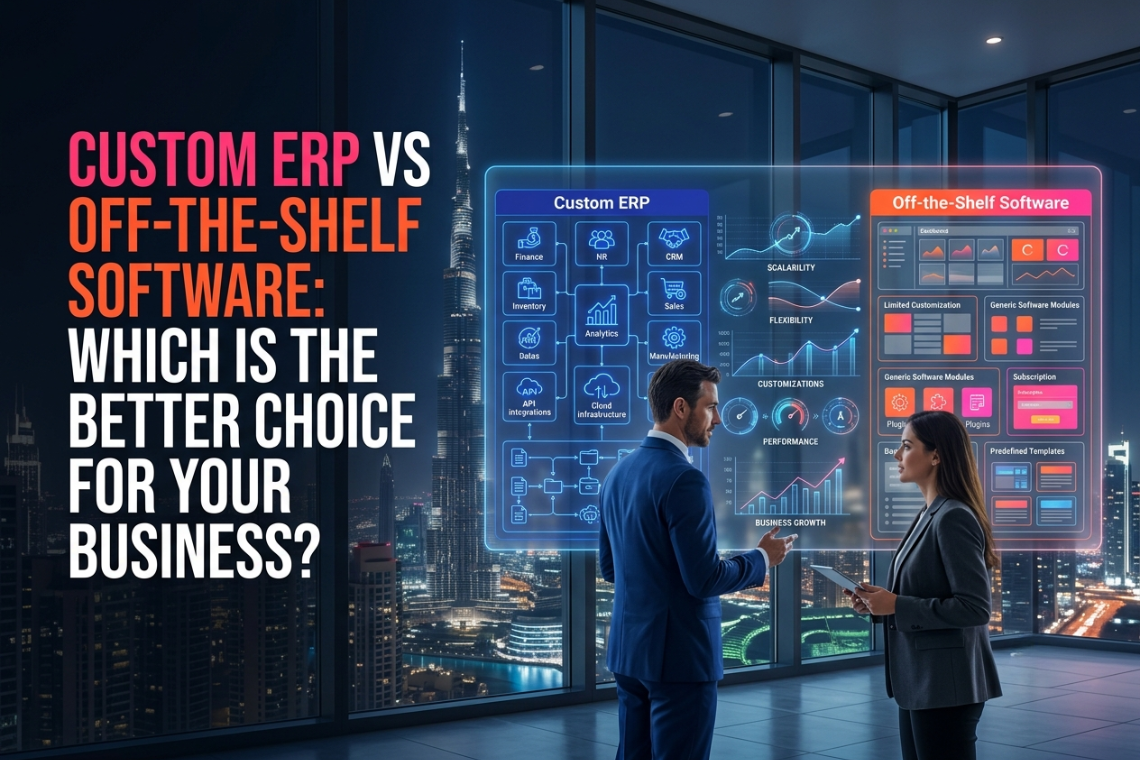
Custom ERP vs Off-the-Shelf Software: Which Is the Better Choice for Your Business?
Choosing an ERP system is one of the most important technology decisions a growing business can make. The right solution can streamline operations, improve productivity, and provide better visibility into every department. The wrong choice, however, can create unnecessary costs, limit flexibility, and make it difficult to adapt as your business grows.
Many businesses begin by comparing two options: custom ERP software and off-the-shelf ERP software. While both are designed to centralize business operations, they differ significantly in terms of flexibility, scalability, implementation, and long-term value.
There isn't a one-size-fits-all answer. The best choice depends on your business model, operational complexity, budget, and future plans.
For businesses in Dubai, where competition and digital transformation continue to accelerate, selecting the right ERP solution can improve efficiency, reduce manual work, and support sustainable growth.
In this guide, we'll compare custom ERP software with ready-made ERP solutions, explain their advantages and limitations, and help you identify which option best fits your business needs.
What Is Custom ERP Software?
Custom ERP software is an enterprise resource planning system developed specifically for a business's unique workflows, processes, and operational requirements. Unlike ready-made ERP platforms, a custom solution is built around the way a business operates, providing greater flexibility, seamless integrations, and long-term scalability.
Depending on business requirements, a custom ERP system may include modules such as:
 Finance and accounting
Inventory management
Sales and purchasing
Customer relationship management (CRM)
Human resources
Project management
Production planning
Reporting and business analytics
Finance and accounting
Inventory management
Sales and purchasing
Customer relationship management (CRM)
Human resources
Project management
Production planning
Reporting and business analytics
Instead of asking employees to adjust their workflows to fit the software, custom ERP software supports the processes already used within the organization.
What Is Off-the-Shelf ERP Software?
Off-the-shelf ERP software is a pre-built solution designed to meet the common operational needs of businesses across different industries.
These systems usually include standard modules for accounting, inventory, sales, purchasing, HR, and reporting. Since they are already developed, businesses can implement them much faster than a custom-built solution.
For organizations with straightforward processes, ready-made ERP software can be a practical starting point. However, as operations become more complex, businesses may encounter limitations in customization, integrations, or workflow flexibility.
Custom ERP vs Off-the-Shelf Software
The main difference between custom ERP software and off-the-shelf ERP software is that custom ERP is built specifically for one business, while off-the-shelf software is designed for general business use. Custom ERP offers greater flexibility, scalability, and integration options, whereas ready-made ERP software typically provides faster implementation and a lower upfront cost.
Custom ERP vs Off-the-Shelf Software: A Quick Comparison
| Feature | Custom ERP Software | Off-the-Shelf ERP Software |
|---|---|---|
| Customization | Built around your business processes | Limited to available features |
| Scalability | Easily expands as your business grows | May require additional modules or upgrades |
| Integration | Connects with existing business systems | Depends on vendor capabilities |
| Implementation | Longer development timeline | Faster deployment |
| Ownership | Greater control over features and updates | Vendor-controlled |
| Initial Investment | Higher | Lower |
| Long-Term Flexibility | Excellent | Moderate |
Benefits of Custom ERP Software
For businesses with specialized operations or long-term growth plans, custom ERP software provides several advantages that standard solutions often cannot match.
1. Built Around Your Business Processes
Every business operates differently. Manufacturing companies, healthcare providers, logistics firms, and service-based businesses often have unique workflows that standard ERP platforms cannot fully support.
A custom ERP system is designed around your existing operations, allowing employees to work more efficiently without changing established processes.
For example, a distribution company may require inventory tracking, warehouse management, and delivery scheduling to work together in one system. A custom solution can be developed to support these specific requirements rather than relying on multiple disconnected applications.
2. Greater Flexibility as Your Business Grows
Business requirements rarely remain the same.
As companies expand into new markets, introduce additional services, or open new branches, their software should be able to grow alongside them.
With custom ERP development, new modules, workflows, dashboards, and integrations can be added whenever they're needed, reducing the likelihood of outgrowing your system in the future.
3. Better Integration with Existing Software
Many businesses already use tools for payroll, accounting, customer management, eCommerce, or reporting.
Rather than replacing every existing system, a custom ERP solution can integrate with the software you already rely on.
This improves data accuracy, reduces manual data entry, and allows information to flow seamlessly between departments.
4. Improved Business Efficiency
Disconnected systems often result in duplicate work, reporting inconsistencies, and communication gaps between departments.
A centralized ERP platform helps teams access the same real-time information, making day-to-day operations more efficient and improving decision-making.
Instead of spending time collecting information from multiple sources, managers can view accurate reports from a single dashboard.
5. Greater Control and Long-Term Value
With a custom ERP solution, your business has greater control over how the software evolves.
You can decide:
Which features to add
How workflows should operate
User roles and permissions
Security requirements
Future enhancements
Third-party integrations
This flexibility allows your ERP system to continue supporting your business as operational requirements change over time.
Benefits of Off-the-Shelf ERP Software
Off-the-shelf ERP software remains a practical choice for businesses with relatively standard operational requirements.
Its main advantages include:
Faster Deployment
Since the software is already built and tested, implementation is typically much quicker than developing a custom ERP solution.
This makes it suitable for businesses that need a system within a shorter timeframe.
Lower Initial Investment
Ready-made ERP software generally requires a smaller upfront investment, making it attractive for startups and small businesses.
However, it's important to evaluate ongoing subscription fees, licensing costs, and future customization expenses rather than considering only the initial price.
Proven Features
Commercial ERP platforms have been used across many industries and include features that address common business requirements.
For businesses with straightforward workflows, these standard capabilities may be sufficient without requiring extensive customization.
Which Option Is More Cost-Effective?
Cost is often one of the first factors businesses consider, but looking only at the purchase price can be misleading. It's more important to evaluate the total cost of ownership, including implementation, maintenance, upgrades, licensing, and future scalability.
Off-the-shelf ERP software usually has a lower upfront cost and can be deployed quickly. However, as your business grows, you may need additional user licenses, paid modules, or third-party integrations, which can increase long-term expenses.
Custom ERP software requires a larger initial investment because it's built specifically for your business. In return, you receive a solution that supports your workflows, reduces manual processes, and can evolve without forcing your team to work around software limitations.
For businesses planning long-term growth, a custom ERP system often provides greater value over time.
How Long Does ERP Implementation Take?
The implementation timeline depends on the type of ERP solution you choose and the complexity of your business operations.
Off-the-shelf ERP software can often be implemented within a few weeks, particularly if only basic configuration and staff training are required.
Custom ERP development usually takes longer because every module is planned, developed, tested, and refined to match your business processes. The timeline varies based on the number of features, integrations, and user requirements.
Although custom development requires more planning, it often reduces operational challenges after deployment because the system is built around the way your business already works.
Which Businesses Should Choose Custom ERP?
It is an excellent choice for:
Manufacturing companies
Wholesale and distribution businesses
Logistics providers
Construction companies
Healthcare organizations
Multi-location businesses
Retail businesses with complex inventory management
Service-based companies with specialized workflowsb
If your business depends on multiple software applications, spreadsheets, or manual reporting, a custom ERP solution can help centralize operations and improve efficiency.
When Is Off-the-Shelf ERP the Right Choice?
Ready-made ERP software is often a practical solution for businesses with standard processes and straightforward operational requirements.
It may be suitable for:
Startups
Small businesses
Companies with limited customization needs
Organizations looking for faster implementation
Businesses with a limited technology budget
As operations become more complex, many organizations eventually require additional customization or migrate to a more flexible ERP platform.
Why Businesses in Dubai Are Investing in Custom ERP Solutions
Businesses across Dubai are increasingly focusing on automation, operational efficiency, and data-driven decision-making. As organizations expand, they need software that supports their unique processes instead of forcing them to adapt to predefined workflows.
This is one of the reasons demand for ERP software in Dubai continues to grow.
Whether it's managing multiple branches, integrating finance and inventory, or automating internal approvals, businesses are looking for systems that improve productivity while supporting long-term growth.
For organizations with industry-specific requirements, ERP solutions in Dubai built through custom ERP development offer the flexibility needed to adapt as business needs change.
How Webtech Digital Helps Businesses Build the Right ERP Solution
Every business operates differently, which is why choosing an ERP system shouldn't be based solely on features or pricing.
At Webtech Digital, we begin by understanding how your business works, identifying operational challenges, and recommending an ERP solution that aligns with your goals. This approach helps ensure the software supports your processes rather than requiring your team to adjust to unnecessary limitations.
Our ERP services include:
Business process analysis
Custom ERP development
ERP module design and customization
Third-party software integration
Dashboard and reporting solutions
System maintenance and ongoing support
By combining technical expertise with practical business understanding, we help organizations implement ERP systems that improve efficiency today while supporting future growth.
Frequently Asked Questions
1. What is custom ERP software?
Custom ERP software is an enterprise resource planning system developed specifically for a business's unique processes and operational requirements. It provides tailored features, better flexibility, and the ability to scale as the business grows.
2. What is the difference between custom ERP and ready-made software?
Custom ERP software is built around your business workflows and can be fully customized. Ready-made ERP software includes standard features designed for a wide range of businesses, offering faster deployment but less flexibility.
3. Which option is more cost-effective?
Off-the-shelf ERP software usually has a lower initial cost, while custom ERP software often provides better long-term value by reducing manual work, supporting business growth, and eliminating unnecessary features or recurring customization costs.
4. How long does custom ERP development take?
The timeline depends on project complexity, required modules, integrations, and testing. Smaller ERP systems may take a few months, while larger enterprise solutions require additional planning and development.
5. Which businesses benefit most from custom ERP?
Businesses with specialized workflows, multiple departments, growing operations, or industry-specific requirements benefit most from custom ERP software. It is particularly valuable for manufacturing, logistics, healthcare, construction, wholesale, and multi-location businesses.
Final Thoughts
Choosing between custom ERP software and off-the-shelf software isn't simply about cost—it's about selecting a solution that supports your business both now and in the future.
If your operations are relatively simple and you need a system quickly, a ready-made ERP platform may be the right choice. However, if your business relies on specialized workflows, requires seamless integrations, or plans to scale over the coming years, investing in a custom ERP solution can provide greater flexibility, efficiency, and long-term value.
Before making a decision, take the time to evaluate your business processes, future goals, and operational challenges. A well-planned ERP investment can improve collaboration, streamline daily operations, and provide the insights needed to make better business decisions.
Looking for the Right ERP Solution in Dubai?
Whether you're planning your first ERP implementation or replacing an existing system, Webtech Digital can help you choose and build a solution that fits your business requirements. Our expertise in custom ERP development and ERP solutions in Dubai enables us to create scalable, secure, and business-focused systems that support long-term success. Contact our team to discuss your ERP requirements and identify the best solution for your organization.
- WordPress Development
- Web Development
- Shopify Development
- Custom e-Commerce
- Custom Software
- Bulk SMS & Business Email
- Graphic Designing
- Logo And Brand Designing
- Website Designing
- Banner Designing
- Digital Marketing
- Search Engine Optimization
- Social Media Optimization
- Social Media Marketing
- Content Marketing
- Google ADS Pay Per Click
- Webtec Portfolio