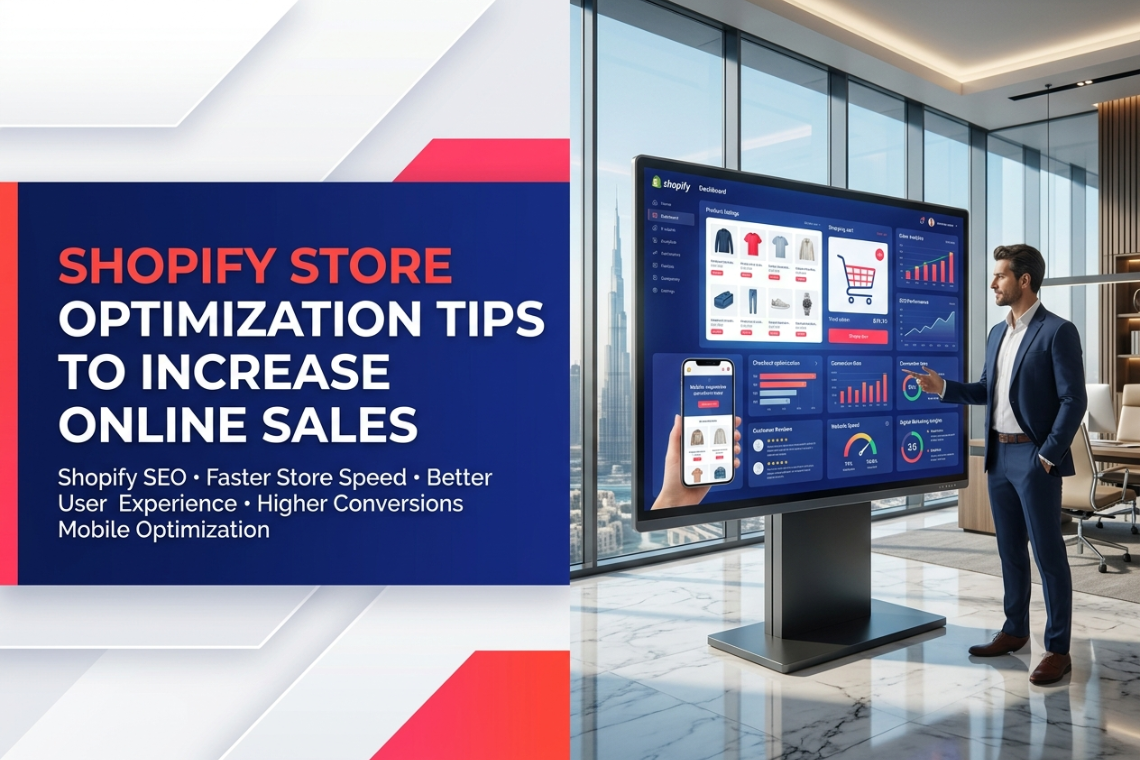
Shopify Store Optimization Tips to Increase Online Sales
Launching a Shopify store is only the first step. The real challenge begins once visitors start arriving. If people browse your products but leave without making a purchase, the issue often isn't your product—it's the shopping experience.
Successful online stores rarely rely on a single factor. Instead, they combine fast performance, clear navigation, informative product pages, and a seamless checkout process to create an experience that encourages customers to buy with confidence.
As eCommerce continues to grow across Dubai and the UAE, shoppers have more choices than ever before. They compare prices, read reviews, and switch between websites within seconds. If your store feels slow, confusing, or difficult to use, most visitors won't wait—they'll move on to another option.
That's why Shopify store optimization is so important. It isn't about making cosmetic changes or chasing every new trend. It's about removing the obstacles that prevent visitors from becoming customers while making your store easier for search engines to understand.
In this guide, you'll learn practical strategies to improve Shopify SEO, create a better shopping experience, and build a store that supports long-term business growth.
What Is Shopify Store Optimization?
Shopify store optimization is the process of improving a Shopify website to increase search visibility, enhance user experience, and generate more sales. It involves optimizing SEO, page speed, product pages, navigation, mobile usability, and the overall customer journey so visitors can find products easily and complete purchases without unnecessary friction.
Why Optimization Matters More Than Design Alone
Many businesses spend weeks choosing colours, fonts, and layouts before launching their Shopify store. While visual design is important, appearance alone won't turn visitors into customers.
Think about your own online shopping habits.
If a website takes too long to load, product information is incomplete, or the checkout process feels complicated, you're unlikely to complete the purchase—even if the products are exactly what you're looking for.
Your customers behave in much the same way.
During Shopify store reviews, it's common to find businesses investing heavily in advertising while overlooking the experience visitors have after clicking the ad. A faster website, better product pages, or a simplified checkout often delivers a greater return than increasing the advertising budget.
The most successful stores focus on making every step of the buying journey simple, clear, and trustworthy.
Build Your Shopify Store on a Strong SEO Foundation
Even the best-designed online store won't attract consistent organic traffic if search engines struggle to understand its content.
That's why seo for shopify store should be considered from the beginning rather than added after the website is launched.
A strong SEO foundation includes:
 Well-organized product categories
Search-friendly URLs
Unique title tags and meta descriptions
Logical internal linking
Optimized product images
Fast-loading pages
Mobile-friendly design
Structured data where appropriate
Well-organized product categories
Search-friendly URLs
Unique title tags and meta descriptions
Logical internal linking
Optimized product images
Fast-loading pages
Mobile-friendly design
Structured data where appropriate
These improvements help search engines crawl your store more efficiently while making it easier for customers to find the products they're searching for.
SEO isn't about trying to rank for every keyword. It's about making your store relevant, useful, and easy to navigate for both users and search engines.
Organize Your Store Around Customer Behaviour
One mistake many businesses make is organising products according to their internal inventory system instead of how customers naturally shop.
Visitors don't know your stock codes or warehouse categories. They expect to browse products in a way that feels logical and intuitive.
A well-structured Shopify store should make it easy for shoppers to move from one page to another without feeling lost.
Some practical ways to improve navigation include:
Creating clearly named product collections
Keeping menus simple and uncluttered
Linking related products together
Adding filters that help customers narrow their choices
Making the search function easy to use
The less effort customers spend looking for products, the more likely they are to continue shopping.
Create Product Pages That Help Customers Make Decisions
Your product pages do far more than describe what you're selling. They answer questions, reduce uncertainty, and build confidence before a purchase.
One of the biggest opportunities we see during Shopify audits is the use of copied manufacturer descriptions. While they're quick to publish, they rarely help your store stand out in search results or give customers enough information to make a buying decision.
A stronger product page usually includes:
Original product descriptions
Clear explanations of benefits, not just features
High-quality product images
Size or specification details where relevant
Delivery and return information
Customer reviews
Frequently asked questions
Instead of simply listing technical features, explain how the product solves a problem or improves the customer's experience. That small change often makes the content more engaging while supporting both SEO and conversions.
Don't Let Website Speed Cost You Sales
Online shoppers expect websites to respond almost instantly.
If a product page takes several seconds to load, many visitors won't wait to see what's on it. They'll simply return to the search results or visit another store.
Common causes of slow Shopify stores include:
Oversized product images
Too many third-party apps
Heavy animations
Unused scripts
Poorly optimized themes
We've seen stores improve performance noticeably simply by removing apps they no longer used. In many cases, reducing unnecessary code has a greater impact than installing additional optimisation tools.
A faster website creates a smoother shopping experience while also supporting stronger Shopify SEO performance.
Does Shopify SEO Help Increase Sales?
Yes. Shopify SEO helps increase sales by improving your store's visibility in search results and attracting visitors who are actively looking for your products. When SEO is combined with fast page speed, well-optimized product pages, and a smooth shopping experience, it can lead to higher-quality traffic, better engagement, and more conversions over time.
Improve the Shopping Experience to Increase Conversions
Getting visitors to your Shopify store is only half the job. What happens after they arrive has an even greater impact on your sales.
Customers don't usually abandon a purchase because of one major problem. More often, it's a combination of small frustrations—a confusing menu, unclear shipping details, a slow-loading page, or a checkout process that feels longer than expected.
Removing those barriers creates a smoother buying experience and encourages more visitors to complete their purchase.
Some improvements that consistently make a difference include:
Clear and visible call-to-action buttons
Simple, distraction-free checkouts
Transparent shipping and return policies
Easy-to-find contact information
Customer reviews and ratings
Secure payment options
Clear stock availability
When customers can find the information they need without searching, they're far more likely to buy with confidence.
Make Mobile Shopping a Priority
A significant percentage of online purchases now begin on smartphones.
Whether someone is comparing products during a lunch break or browsing while travelling, they expect the same smooth experience they would get on a desktop.
Unfortunately, many Shopify stores still create unnecessary friction on mobile devices. Small buttons, slow-loading pages, and difficult navigation often lead visitors to leave before reaching checkout.
A mobile-friendly Shopify store should offer:
Responsive design
Fast page loading
Readable product descriptions
Easy-to-tap buttons
Simple navigation
Mobile-friendly checkout
Improving the mobile experience benefits both your customers and your search visibility, making it one of the most valuable investments for long-term growth.
Choose Shopify Apps Carefully
One of Shopify's biggest strengths is its extensive app ecosystem. However, adding too many apps can create new problems instead of solving existing ones.
Every additional app introduces extra code that may affect loading speed, compatibility, or overall performance.
Before installing a new app, ask yourself a simple question:
Does this genuinely improve the customer experience?
For many businesses, a smaller collection of well-chosen apps performs better than a store overloaded with unnecessary features.
Useful app categories include:
Product reviews
Email marketing
Inventory management
Customer support
Analytics and reporting
Wishlist functionality
Upselling and cross-selling
Regularly reviewing installed apps helps keep your store fast, stable, and easier to manage.
Track Performance and Keep Improving
They monitor customer behaviour, identify opportunities for improvement, and make regular updates based on real data.
Some key performance indicators worth tracking include:
Conversion rate
Cart abandonment rate
Average order value
Bounce rate
Best-performing products
Traffic sources
These insights help you understand where customers are dropping off and which improvements are likely to deliver the greatest return.
Optimisation works best as an ongoing process rather than a one-time project.
Why Shopify SEO Supports Sustainable Growth
Many online businesses rely heavily on paid advertising to generate sales. While paid campaigns can produce quick results, traffic usually stops when the advertising budget ends.
Organic search works differently.
A well-planned Shopify SEO strategy helps your products appear when customers are actively searching for them, creating a steady source of qualified traffic over time.
An effective SEO strategy typically focuses on:
Original product descriptions
Optimised collection pages
Internal linking
Image optimisation
Technical SEO improvements
Helpful content that answers customer questions
Businesses that work with professionals experienced in shopify experts seo often build stronger technical foundations while avoiding common optimisation mistakes that limit organic growth.
Why Local Expertise Can Make a Difference
Every market has its own customer behaviour, competition, and search trends.
Businesses targeting customers in Dubai and across the UAE often benefit from working with a Shopify expert Dubai companies trust—someone who understands both the local market and the technical side of eCommerce.
Professional support can help with:
Shopify store setup and customization
Performance optimisation
Technical SEO
Conversion-focused improvements
Ongoing maintenance
Store audits and recommendations
At Webtech Digital, every Shopify project begins with understanding the business rather than applying a standard checklist. By reviewing customer behaviour, website performance, and search visibility together, the team identifies practical improvements that support better user experiences and long-term online growth.
Final Thoughts
Building a Shopify store is an important milestone, but continuous improvement is what drives sustainable results.
Instead of focusing on one major change, look for opportunities to refine the overall shopping experience. Faster pages, clearer product information, intuitive navigation, and a well-planned SEO strategy all contribute to stronger customer engagement and higher online sales.
The most successful Shopify stores aren't necessarily the most complex. They're the ones that make shopping feel simple, reliable, and enjoyable from the first click to the final checkout.
Frequently Asked Questions
1. What is Shopify store optimization?
Shopify store optimization is the process of improving a Shopify store's SEO, speed, navigation, product pages, and user experience to help attract more visitors and increase conversions.
Is Shopify suitable for online stores in Dubai?
Yes, Shopify is widely used for ecommerce in Dubai because it simplifies product management and payments.
2. How can I increase conversions on Shopify?
You can improve conversions by simplifying navigation, speeding up your website, creating informative product pages, displaying customer reviews, providing clear shipping information, and making the checkout process quick and user-friendly.
3. Does Shopify SEO help increase sales?
Yes. Shopify SEO helps improve your store's visibility in search results, attracting visitors who are actively looking for your products. When combined with a positive shopping experience, it can contribute to increased traffic, better engagement, and higher sales over time.
4. Which Shopify apps improve store performance?
The best apps depend on your business goals. Many Shopify stores benefit from apps for customer reviews, analytics, inventory management, email marketing, upselling, and customer support. Installing only the apps you genuinely need helps maintain better website performance.
5. How can I improve my Shopify product pages?
Create original product descriptions, use high-quality images, explain the benefits of each product, include clear specifications, answer common customer questions, display reviews, and make your call-to-action easy to find. A well-structured product page helps customers make informed purchasing decisions.
- WordPress Development
- Web Development
- Shopify Development
- Custom e-Commerce
- Custom Software
- Bulk SMS & Business Email
- Graphic Designing
- Logo And Brand Designing
- Website Designing
- Banner Designing
- Digital Marketing
- Search Engine Optimization
- Social Media Optimization
- Social Media Marketing
- Content Marketing
- Google ADS Pay Per Click
- Webtec Portfolio