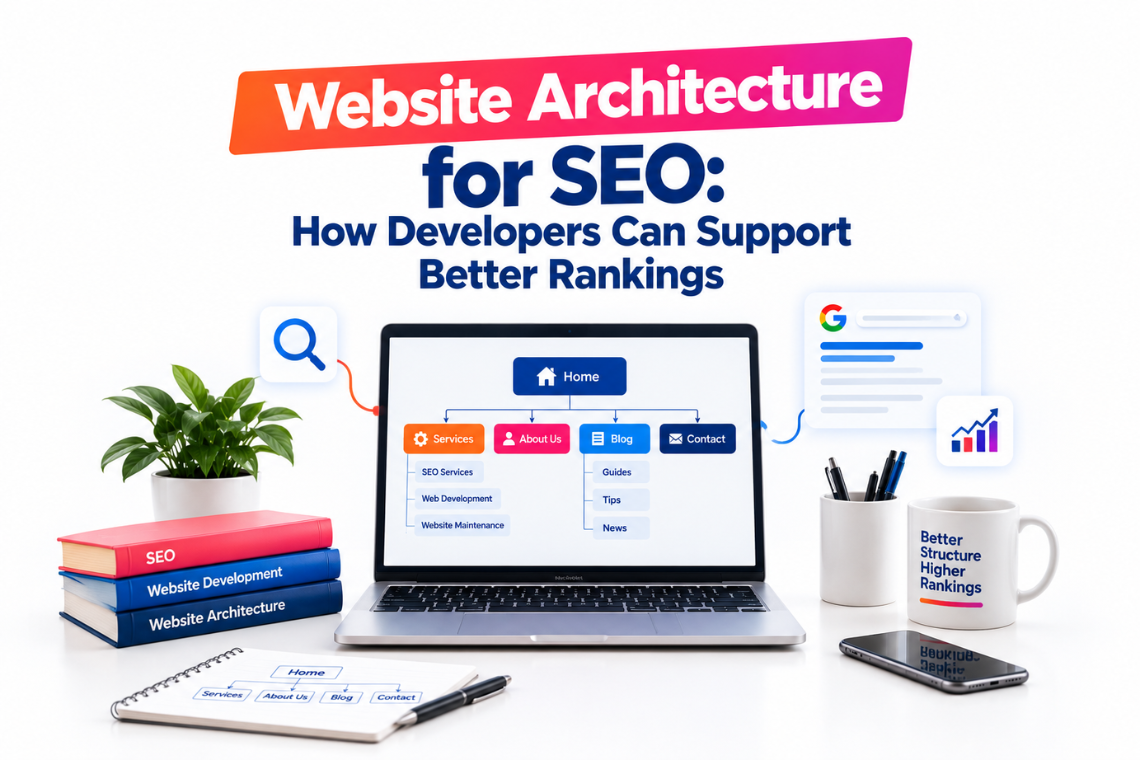
Website Architecture for SEO: How Developers Can Support Better Rankings
A website may look professional and offer useful information, yet still struggle to attract organic traffic. Sometimes, the problem is not the content itself but the way the website is organised.
When important pages are buried under several layers, internal links are missing, or multiple URLs lead to similar content, search engines can have difficulty identifying which pages matter most. Visitors may also leave without finding the information they came for.
This is where website architecture for SEO becomes important.
For developers, SEO is not something to add after a website has been built. Decisions about navigation, URLs, page templates and rendering can influence how effectively a website performs in search. Getting these fundamentals right from the beginning makes future optimisation easier and reduces the need for expensive structural changes.
For businesses in Dubai and across the UAE, a well-planned website structure can support organic visibility while making it easier for potential customers to evaluate services and get in touch.
What Is Website Architecture in SEO?
Website architecture in SEO describes how a website's pages are organised and connected through navigation, categories, URLs and internal links. It establishes a logical relationship between the homepage, service pages, category pages and supporting content.
A good structure helps visitors find information without unnecessary steps. It also gives search engines clear paths to follow when crawling the website.
Consider a digital agency with separate services for SEO, web development and website maintenance. If these pages are grouped under relevant sections and connected to useful supporting articles, visitors can understand the agency's services more easily.
The same website becomes harder to navigate when every page sits at the same level, menus contain unrelated links, or important services are accessible only through internal searches.
The objective is not to create the deepest or most complicated hierarchy. It is to organise information around the needs of the audience and the purpose of each page.
How Does Website Structure Affect Search Engine Crawling?
Website structure influences how search engines find pages, follow links and understand the relationships between different sections. Clear navigation and relevant internal links make important URLs easier to reach, while broken links and unnecessary URL variations can complicate crawling.
Three elements deserve particular attention:
 Crawlability: Can search engine crawlers access important pages and follow their links?
Indexability: Are the pages eligible to appear in search results, subject to search engine processing?
Page relationships: Does the structure make it clear how individual pages relate to broader topics and services?
A sitemap can help search engines identify URLs, but it does not guarantee that every URL will be crawled or indexed. Likewise, a page being accessible does not automatically mean it deserves to rank.
Developers should therefore treat architecture as one part of a wider SEO strategy, alongside content relevance, technical quality and user experience.
Building an SEO-Friendly Website Structure
Start With the Way Customers Look for Information
The structure should reflect what visitors want to accomplish, rather than simply mirroring the company's internal departments.
For example, someone looking for website maintenance services in Dubai may want to understand what is included, how support works and whether the provider handles their website platform. Those needs should guide the page structure and navigation.
Before development begins, review the main services, audience requirements, existing URLs and search intent behind important keywords. Group related topics together and give each page a clear purpose.
A business website might use the following hierarchy:
Home
Services
SEO Services
Website Development
Website Maintenance
Resources
Technical SEO Guides
Website Development Articles
About Us
Contact
This is a starting point, not a fixed template. A small business may need only a few levels, while a large e-commerce website may require more detailed category and subcategory structures.
What matters is that users can understand where they are and reach important information without navigating through unrelated pages.
Keep Important Pages Within Easy Reach
A page does not become important simply because it sits close to the homepage. However, when valuable content is buried deep in the navigation or receives very few internal links, users and crawlers may have more difficulty reaching it.
Review how many clicks it takes to reach key service pages, product categories and useful resources. Where necessary, introduce relevant category links, contextual links or breadcrumbs.
Avoid adding extra layers merely to make the hierarchy appear organised. Each level should serve a clear purpose.
For growing websites, this planning also prevents new pages from being added randomly. A defined structure gives content teams and developers a consistent way to organise future additions.
Create an SEO-Friendly URL Structure
URLs should tell users what a page is about without unnecessary complexity.
For example:
example.com/services/website-maintenance/
is easier to interpret than:
example.com/page?id=4827
The first URL communicates the page topic and its place within the website. Although descriptive URLs can improve clarity, they are not a guarantee of higher rankings.
When planning an SEO-friendly URL structure, use readable words, hyphens between terms and a consistent naming convention. Avoid unnecessary parameters, repetitive folder names and frequent URL changes.
Existing websites require additional care. Changing established URLs without a clear reason can disrupt internal links and affect how search engines process previously indexed pages.
If a URL must change, developers should implement an appropriate permanent redirect, update internal links and review canonical tags and XML sitemaps. Redirects should point to the closest relevant replacement rather than sending every old URL to the homepage.
Consistency is more valuable than repeatedly changing URLs to include additional keywords.
Internal Linking Website Architecture: Connecting Related Pages
Internal links do more than help visitors move around a website. They create relationships between pages and give search engines additional routes to follow.
Imagine a website publishing an article about improving page speed. The article could link naturally to a website maintenance service, a guide to Core Web Vitals and a related technical SEO resource.
Each link gives readers a relevant next step while connecting related information.
A practical internal linking strategy should focus on relevance rather than link quantity. Use descriptive anchor text, link to useful resources and ensure important commercial pages receive links from appropriate sections of the website.
New articles should also be linked from existing, relevant pages where it makes sense. Publishing a page without connecting it to the rest of the website can leave it isolated.
During an audit, pay particular attention to orphan pages, broken links and important pages that receive very few internal links. These issues can often be resolved without redesigning the entire website.
Technical SEO Website Development: Details Developers Should Get Right
Website architecture can look perfect on a planning document and still fail in practice if the technical implementation is incorrect.
Check Crawlability, Indexing and Canonical Signals
Important pages should return appropriate HTTP status codes and remain accessible to search engine crawlers. Developers should also review robots.txt rules, Meta robots directives, canonical tags and XML sitemaps.
These elements serve different purposes. Robots.txt primarily controls crawling, while a noindex directive can tell a compliant search engine not to index a page. Canonical tags indicate the preferred URL among duplicate or substantially similar versions.
Confusing these signals can create avoidable problems. For example, blocking a page in robots.txt does not reliably remove an already indexed URL from search results.
Use Google Search Console to investigate indexing issues and inspect important URLs after significant website changes. Automated crawls can also identify redirect chains, broken internal links and unexpected response codes.
Make JavaScript-Rendered Content Accessible
JavaScript frameworks are common in modern website development, but their implementation deserves attention when SEO matters.
Important headings, service descriptions, internal links and page metadata should be available to search engines after rendering. Navigation that depends entirely on inaccessible interactions can make page discovery more difficult.
Server-side rendering and static generation may help in suitable projects, but neither approach is mandatory for every website. The right choice depends on the framework, application requirements and how content is delivered.
Test important page templates rather than assuming that everything visible in a browser is processed as expected.
Treat Performance as Part of Development
A complicated website can frustrate visitors even when its navigation is logically arranged. Large images, unnecessary scripts and unstable layouts can make pages slower or harder to use, particularly on mobile connections.
Developers should optimise image sizes, reduce unnecessary code, use appropriate caching and prevent avoidable layout shifts. Core Web Vitals provide useful measurements of loading performance, responsiveness and visual stability.
These improvements do not replace relevant content or sound architecture. They help ensure that the structure works well for real users.
Common Website Architecture Mistakes to Avoid
Structural problems often appear gradually as a website grows. New landing pages are added, old URLs remain active and internal links are forgotten.
The most common issues include:
Orphan pages: Important content has no internal links pointing to it.
Duplicate URL variations: Similar pages are accessible through multiple URLs without appropriate canonicalisation.
Unnecessary navigation depth: Visitors must pass through several irrelevant sections to reach useful information.
Poor redirect handling: Old URLs lead to chains, loops or unrelated destinations.
Uncontrolled filter URLs: E-commerce filters generate large numbers of low-value URL combinations.
Incorrect indexing directives: Valuable pages are accidentally blocked or marked noindex.
Regular technical audits help identify these issues before they affect a larger section of the website. After resolving them, monitor crawl reports, indexing signals and organic landing-page performance to understand whether the changes are helping.
Measuring the Results of Website Architecture Improvements
SEO-friendly website structure should be evaluated through actual website data, not assumptions.
Google Search Console can show which pages receive impressions and clicks, while technical crawling tools can identify broken links, redirect problems and pages with limited internal connections.
Analytics data can help establish whether visitors are reaching important service pages and completing meaningful actions, such as submitting an enquiry.
Record a baseline before making major structural changes. Review performance over time and consider other changes made to content, backlinks and page templates. Search rankings fluctuate for several reasons, so improvements should not automatically be attributed to architecture alone.
For businesses planning a new website or reviewing an existing one, technical SEO should be part of the development process rather than a final checklist. Webtech Digital works across website development and digital marketing, making it relevant for businesses that want their website structure and search visibility objectives to work together.
Frequently Asked Questions
1. What is website architecture in SEO?
Website architecture in SEO is the organisation of a website's pages, navigation, URLs and internal links. A logical structure helps visitors find information and provides search engines with clearer routes to important content.
2. How does website structure affect search engine crawling?
Website structure affects how search engines access and follow links between pages. Clear navigation, relevant internal links and appropriate crawl settings support page discovery, while broken links and unnecessary URL variations can create obstacles.
3. What is the best URL structure for an SEO-friendly website?
The best URL structure uses short, descriptive and consistent paths that reflect the page topic. Use readable words, hyphens and a logical hierarchy. Avoid unnecessary parameters and change established URLs only when there is a clear reason.
4. How does internal linking support website rankings?
Internal linking helps search engines find pages and understand their relationships with other content. It also guides visitors towards relevant information and services. Useful internal links support SEO, but they do not guarantee improved rankings.
5. What website architecture mistakes can hurt SEO?
Common mistakes include orphan pages, broken internal links, excessive navigation depth, duplicate URL variations, incorrect canonical tags and poorly managed redirects. Regular technical audits help developers identify and resolve these problems.
Final Thoughts
A well-structured website is easier to navigate, maintain and expand. Clear categories, consistent URLs, relevant internal links and accessible technical implementation provide a stronger foundation for long-term SEO.
For businesses in Dubai, these decisions can also make the difference between a website that simply presents information and one that helps potential customers find the right service.
Planning a new website or improving your existing structure? Contact Webtech Digital to discuss website development and technical SEO services in Dubai, with an approach tailored to your website's requirements and business objectives.
- WordPress Development
- Web Development
- Shopify Development
- Custom e-Commerce
- Custom Software
- Bulk SMS & Business Email
- Graphic Designing
- Logo And Brand Designing
- Website Designing
- Banner Designing
- Digital Marketing
- Search Engine Optimization
- Social Media Optimization
- Social Media Marketing
- Content Marketing
- Google ADS Pay Per Click
- Webtec Portfolio