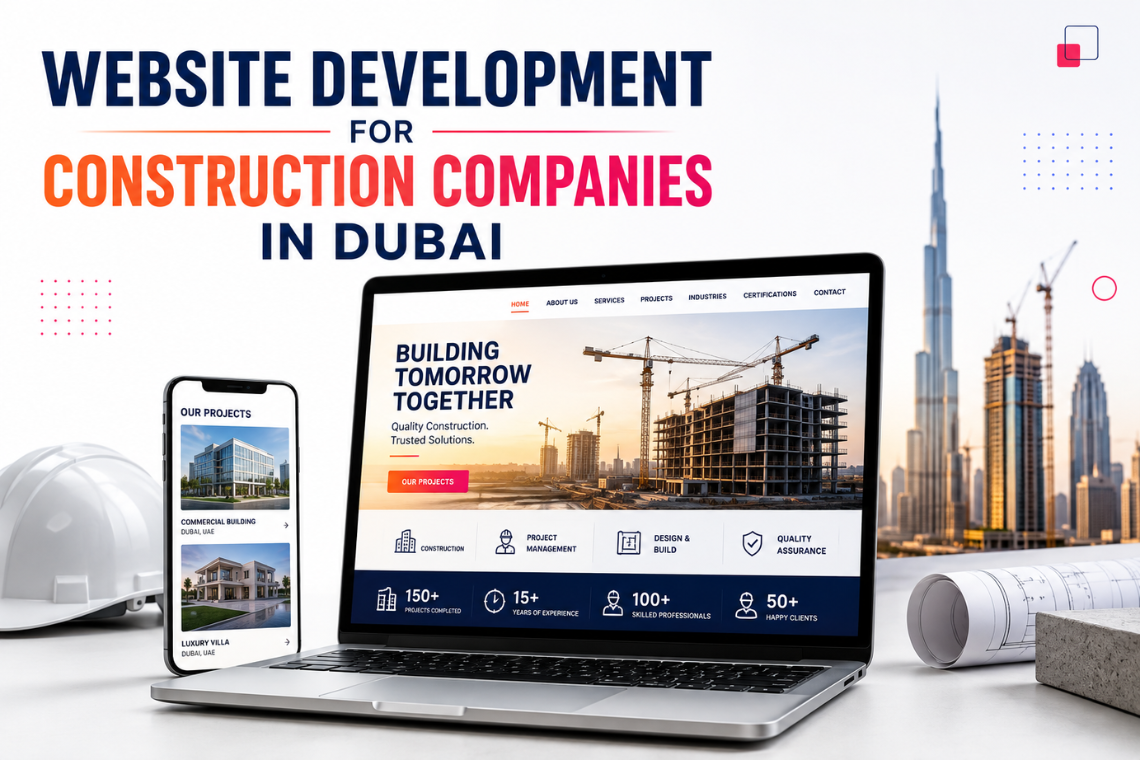
Website Development for Construction Companies in Dubai
For a construction company, a website is often the first place a potential client goes to understand the business before making an enquiry. They may want to see completed projects, review services, check company credentials, or simply decide whether the contractor looks suitable for their requirements.
This makes the website much more than an online company profile.
For construction businesses in Dubai, the website needs to present experience clearly while making it easy for visitors to understand what the company does and how they can get in touch. It also needs to work well on mobile devices, load quickly, and provide a solid foundation for search visibility.
A well-planned website brings all of these elements together. It presents the company's work professionally without making the visitor search through unnecessary pages or complicated menus.
Why Does a Construction Company Need a Professional Website?
A professional website gives a construction company a central place to present its capabilities, previous work, services, and credentials.
Potential clients can use the website to evaluate the business before starting a conversation. This is particularly useful for construction projects where clients may need to compare several companies before deciding whom to contact.
A strong website can help showcase:
 Completed and ongoing projects
Construction and contracting services
Company experience
Areas of expertise
Certifications and professional credentials
Industries served
Project locations
Contact and enquiry options
Completed and ongoing projects
Construction and contracting services
Company experience
Areas of expertise
Certifications and professional credentials
Industries served
Project locations
Contact and enquiry options
The website should answer the visitor's most important questions without making the process complicated.
What Makes a Construction Company Website Effective?
A good construction website does not need to be overloaded with animations, technical features, or dozens of pages.
It needs to provide the right information in a clear and organised way.
An effective construction website should make three things obvious:
What services does the company provide?
What experience or capability does it have?
How can a potential client get in touch?
When these answers are easy to find, visitors can move through the website with much less friction.
Build a Clear Website Structure
Construction companies often provide several services, and each one may appeal to a different type of client.
Trying to explain everything on a single page can make the website difficult to understand. A better approach is to create a logical structure that gives important services and projects enough space.
A typical structure may include:
Home
About Us
Services
Projects
Industries
Certifications
Insights or Blog
Contact
Individual services can have dedicated pages where detailed information is useful.
This also creates a stronger foundation for SEO because search engines can better understand the purpose of individual pages.
Give Your Project Portfolio the Attention It Deserves
For construction companies, previous projects are often more convincing than a long list of marketing statements.
A project portfolio should therefore do more than display photographs in a gallery.
Where possible, individual project pages can explain:
Project name
Location
Type of project
Scope of work
Services provided
Project status
Key challenges
Relevant technical details
High-quality project images
For example, instead of simply displaying a photograph with the title "Commercial Project," explain what the company was responsible for and what type of work was completed.
This gives potential clients a much clearer idea of the company's actual capabilities.
What Should a Construction Company Website Include?
A professional construction company website should include clear service pages, a well-organised project portfolio, company information, relevant certifications and credentials, mobile-friendly design, fast performance, contact details, and simple enquiry options.
The exact features should depend on the company's services, target clients, project types, and business goals.
Design the Website Around the Industry
Construction websites rely heavily on visual proof. Good photographs of completed developments, construction work, teams, equipment, and project stages can help communicate the quality and scale of a company's work.
This is where thoughtful web design in Dubai becomes important.
The design should support the company's work rather than distract from it.
Useful elements may include:
Large but optimized project images
Clear service sections
Simple navigation
Strong headings
Project categories or filters
Well-structured content
Visible contact options
Responsive layouts
A professional design should also reflect the type of clients the company wants to attract. A contractor working primarily with commercial developers may require a different presentation from a company focused on residential projects.
Make the Website Mobile-Friendly
Potential clients may visit a construction website while travelling between meetings, visiting a project, or simply browsing from their phones.
A website that works well only on a desktop is therefore likely to create unnecessary problems.
Mobile usability should cover:
Readable text
Easy navigation
Properly sized buttons
Responsive images
Fast loading
Simple forms
Easy access to phone and contact details
The mobile experience should not feel like a reduced version of the desktop website. Important information should remain easy to find regardless of screen size.
Create Service Pages That Actually Explain the Services
A service page should provide more than a heading and a short paragraph.
If a company provides commercial construction, fit-out, civil works, renovation, infrastructure, or project management, the relevant page should explain what the company actually delivers.
A useful service page can cover:
What the service involves
Types of projects handled
Typical client requirements
Scope of work
Relevant experience
Project considerations
How to request more information
This approach is useful for visitors and gives search engines better context about the business.
The pages should reflect genuine services offered by the company rather than being created simply to target additional search terms.
Use Local SEO Naturally
For a company serving Dubai, local visibility can play an important role in attracting relevant enquiries.
However, location keywords should not be repeated throughout every paragraph.
Instead, local relevance can be established through:
Accurate business information
Google Business Profile
Office location
Project locations
Service areas
Relevant local references
Location-specific pages where genuinely useful
For example, if the company has completed commercial construction projects in Dubai, those projects can naturally mention their locations and scope.
This provides useful information while also strengthening local relevance.
How Can a Construction Website Generate More Leads?
A construction website can generate more leads by clearly presenting services, showcasing completed projects, demonstrating relevant experience, providing trust signals, targeting useful search queries, and making it easy for visitors to request a quotation, consultation, or project discussion.
The website should create a straightforward path from research to enquiry without forcing visitors through unnecessary steps.
Make the Enquiry Process Simple
Getting visitors to the website is only part of the job. The website also needs to make contacting the company easy.
Useful conversion options include:
Request a quotation
Discuss a project
Request a consultation
Submit project requirements
Call the company
Send an enquiry
Forms should collect enough information to understand the enquiry without becoming unnecessarily long.
For larger construction projects, it may be useful to ask about the project type, location, approximate scope, and contact details.
The important thing is to make the next step obvious.
Use Trust Signals That Support Credibility
Construction projects can involve substantial budgets and long timelines. Potential clients therefore need confidence in the company before making contact.
A website can support that confidence through factual information such as:
Years of relevant experience
Completed projects
Professional qualifications
Certifications
Safety credentials
Industry memberships
Client sectors
Team information
Genuine testimonials, where appropriate
Avoid exaggerated claims that cannot be supported. Specific project information and verifiable credentials are generally more convincing.
Don't Ignore Website Performance
A construction website may contain many large photographs, videos, project galleries, and other visual elements.
Without proper optimization, these can make pages unnecessarily heavy.
Website performance should therefore be considered during development.
Important areas include:
Image compression
Correct image dimensions
Modern image formats
Lazy loading
Efficient CSS and JavaScript
Browser caching
Reliable hosting
Limited third-party scripts
The objective is to maintain strong visual presentation without making visitors wait for the page to become usable.
Build SEO Into the Development Process
SEO works better when it is considered during development instead of being added after the website is complete.
A technically sound website should have:
Logical URLs
Descriptive page titles
Relevant meta descriptions
Proper heading hierarchy
Internal links
Descriptive image ALT text
XML sitemap
Canonical tags where necessary
Mobile responsiveness
Crawlable navigation
Appropriate structured data
Content should also be written around genuine user needs.
Repeating phrases such as "construction company in Dubai" throughout a page does not make the content more useful. Natural language and clear topical coverage are more appropriate.
Use Content to Support Long-Term SEO
A construction company does not need to publish articles simply to keep its blog active.
The better approach is to create content around questions and topics that are relevant to its potential clients.
Depending on the company's expertise, useful topics could cover:
Construction project planning
Commercial development considerations
Fit-out planning
Construction cost factors
Project timelines
Building materials
Sustainable construction
Construction technology
Project management challenges
Well-researched content can attract relevant search traffic while giving prospective clients a better understanding of the company's expertise.
Choose the Right Development Partner
Selecting a web development company in Dubai should involve more than comparing website designs or development prices.
A construction business should consider whether the development team understands:
Business objectives
User experience
Technical SEO
Mobile performance
Content structure
Lead generation
Website security
Ongoing maintenance
The development process should begin with understanding the company's services, clients, projects, and objectives rather than simply selecting a template.
Webtech Digital approaches website development with these broader requirements in mind, combining professional presentation with practical navigation, search-friendly foundations, responsive development, and clear opportunities for potential clients to make contact.
How Long Does Website Development Take?
There is no standard development timeline for every construction company.
A straightforward corporate website with a small number of pages will generally require less development work than a custom website containing numerous service pages, project case studies, integrations, and specialised functionality.
The timeline can depend on:
Number of pages
Design requirements
Custom functionality
Content availability
Number of projects
Third-party integrations
SEO requirements
Approval timelines
Having the content, project information, images, and business details ready can help keep development moving efficiently.
Final Thoughts
For construction companies in Dubai, a website should do more than display a company name, logo, and contact number.
It should communicate experience, present projects properly, explain services clearly, build confidence, and make it easy for potential clients to take the next step.
Strong web design, responsive development, useful content, technical SEO, local relevance, and good website performance all contribute to that experience.
The best construction website is not necessarily the one with the most pages or visual effects. It is the one that gives visitors the information they need and makes the next action straightforward.
If your construction company needs a professional website that presents its projects clearly while supporting search visibility and lead generation, contact Webtech Digital to discuss your website development requirements.
Frequently Asked Questions
Why does a construction company need a professional website?
A professional website gives a construction company a central place to present its services, completed projects, experience, credentials, and contact information. It can help potential clients evaluate the company before making an enquiry and provide a foundation for SEO and online lead generation.
What features should a construction company website include?
A construction company website should generally include clear service pages, a project portfolio, company information, relevant certifications and credentials, contact and enquiry options, responsive design, fast performance, mobile usability, and search-friendly technical foundations. The exact features should reflect the company's services and target audience.
How much does a construction company website cost in Dubai?
The cost depends on factors such as the number of pages, design requirements, functionality, level of customization, content requirements, integrations, and ongoing maintenance. A simple corporate website will generally require less development work than a custom website with extensive project portfolios and specialised functionality.
Can a website help construction companies generate more leads?
Yes. A well-structured website can support lead generation by clearly presenting services, showcasing completed projects, building trust, targeting relevant searches, and making it easy for visitors to request a quotation or consultation. The number and quality of leads will depend on website performance, traffic, search visibility, and the effectiveness of the conversion process.
How long does it take to develop a construction company website?
The timeline depends on the size and complexity of the website. A straightforward corporate website can be completed faster than a custom website with extensive project portfolios, multiple service pages, integrations, and specialised functionality. Content preparation, revisions, and client approval can also affect the overall timeline.
- WordPress Development
- Web Development
- Shopify Development
- Custom e-Commerce
- Custom Software
- Bulk SMS & Business Email
- Graphic Designing
- Logo And Brand Designing
- Website Designing
- Banner Designing
- Digital Marketing
- Search Engine Optimization
- Social Media Optimization
- Social Media Marketing
- Content Marketing
- Google ADS Pay Per Click
- Webtec Portfolio